
Pima Cotton Explained: What Makes It the World's Finest Cotton
If you've shopped for a premium t-shirt, a luxury sweater, or high-end bed sheets, you've probably seen "Pima cotton" on the label and wondered whether it's worth the higher price. The short answer is yes, and there's real science behind it. This guide explains what Pima cotton actually is, what makes it different from the cotton in most clothing, where the best of it comes from, and how to tell the genuine article from the many imitations on the market.
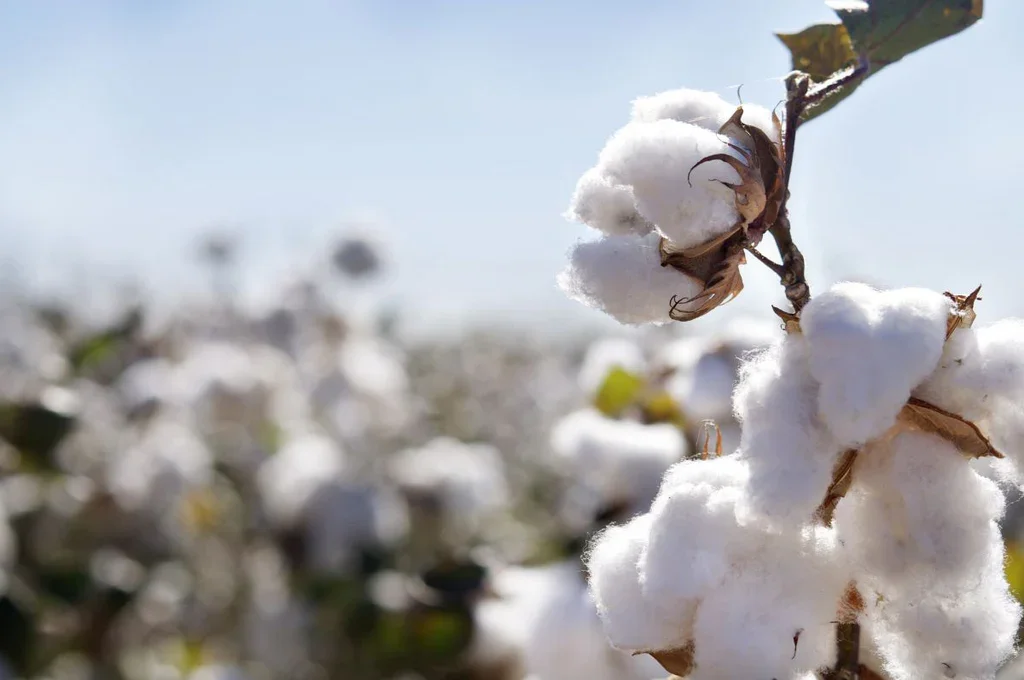
What is Pima cotton?
Pima cotton is a premium type of extra-long staple (ELS) cotton grown from the plant species Gossypium barbadense. "Staple" refers to the length of the individual cotton fibers, and Pima's fibers are unusually long, which is the single most important reason it feels softer, lasts longer, and resists wear better than ordinary cotton.
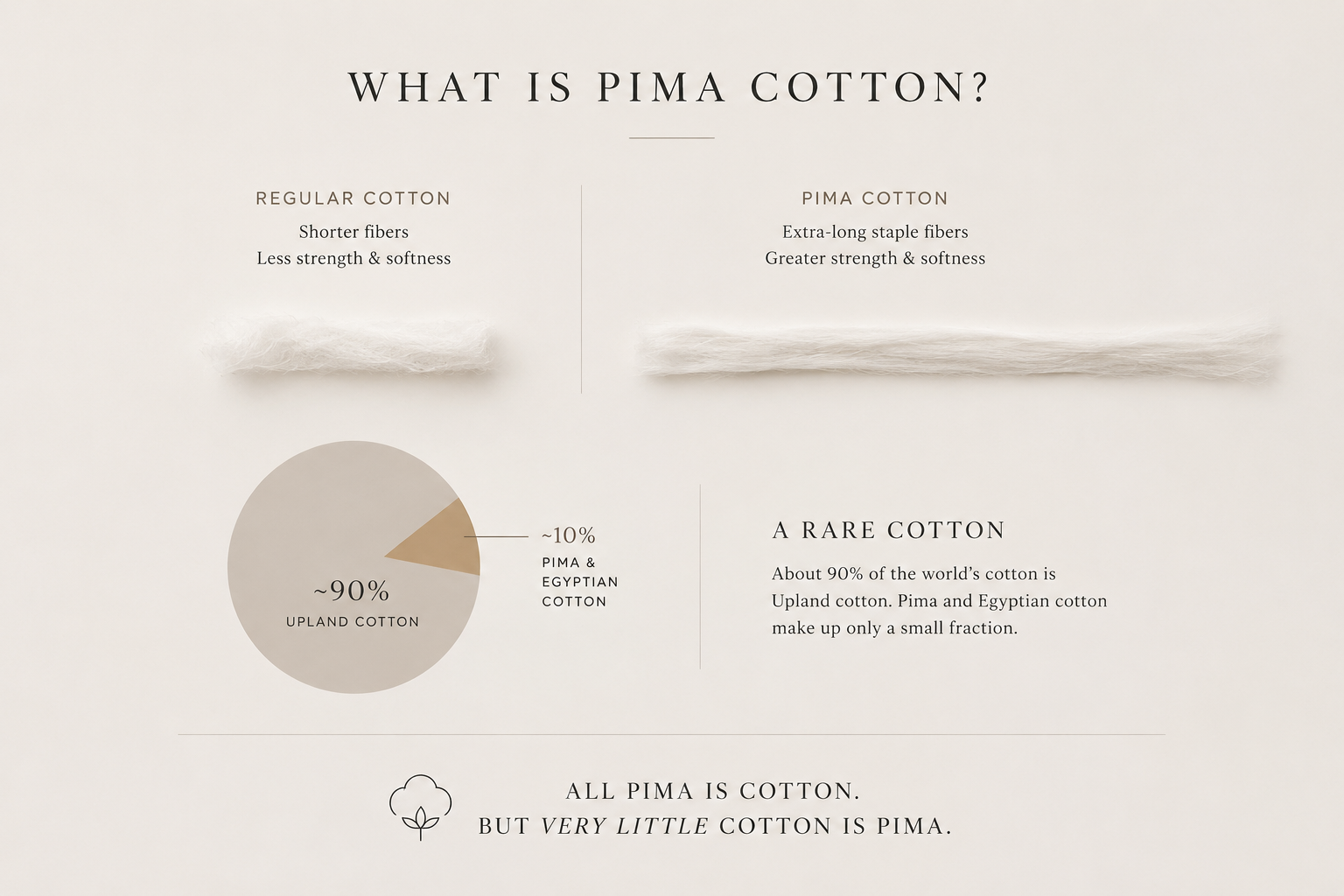
Most of the cotton in the world, roughly 90% of global production, comes from a different species, Gossypium hirsutum, commonly called Upland cotton. Pima and its close cousin Egyptian cotton make up only the remaining sliver of the market, which is exactly why Pima is treated as a luxury fiber rather than a commodity.
Why fiber length matters so much
Cotton is graded in large part by staple length, the average length of the fibers. This is where Pima pulls away from the pack.
Regular Upland cotton has fibers of about 1.0 to 1.1 inches (roughly 20–29 mm).
Pima cotton has fibers of 1.4 inches and up, sometimes reaching close to 2 inches (about 34–40 mm) (Cotton Gins, Sewport).
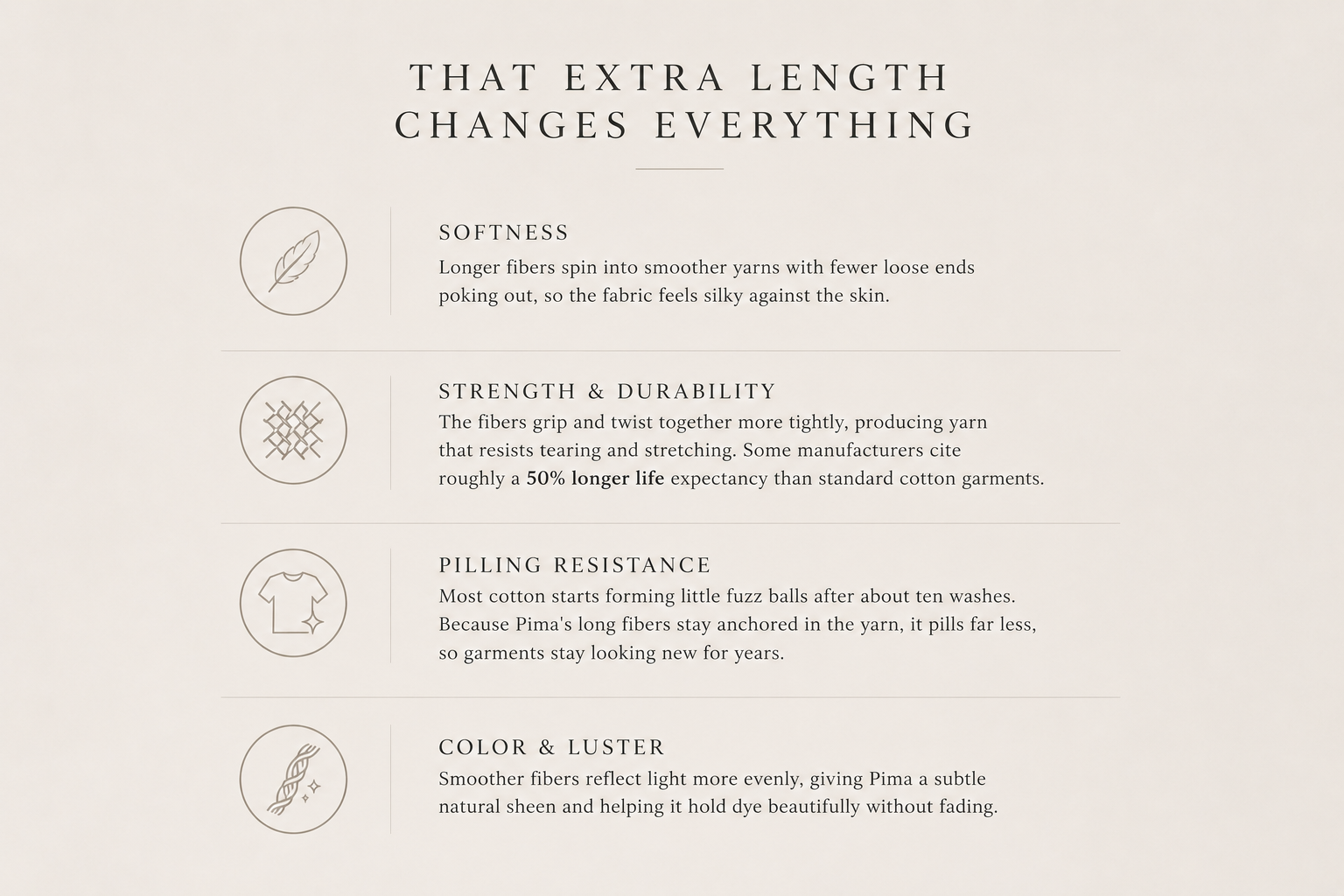
That extra length changes everything about the finished fabric:
Softness. Longer fibers spin into smoother yarns with fewer loose ends poking out, so the fabric feels silky against the skin (Cotton Gins).
Strength and durability. The fibers grip and twist together more tightly, producing yarn that resists tearing and stretching. Some manufacturers cite roughly a 50% longer life expectancy than standard cotton garments (Authenticity50).
Pilling resistance. Most cotton starts forming little fuzz balls after about ten washes. Because Pima's long fibers stay anchored in the yarn, it pills far less, so garments stay looking new for years (Sewport).
Color and luster. Smoother fibers reflect light more evenly, giving Pima a subtle natural sheen and helping it hold dye beautifully without fading.
Peruvian Pima in particular is also a very fine fiber — measured at roughly 3.4 to 3.6 microns — which is part of what gives it that signature silky hand (Intifil).
Where the best Pima cotton is grown today
Pima needs a very specific climate to thrive: warm, dry, and frost-free, since Gossypium barbadense is highly sensitive to cold (Sewport). Today it's grown commercially in three main places:
Peru — primarily the Piura and Chira valleys on the northern coast, where the soil and equatorial climate are considered close to ideal (ARKET).
The United States — limited to warm, dry states like California, Arizona, New Mexico, and Texas, where it makes up only a small fraction of total U.S. cotton (Advance Textile).
Australia — a smaller but well-regarded producer (Cotton Gins).
What makes Peruvian Pima special
Peruvian Pima is widely regarded as among the finest in the world, and the reason isn't only the climate — it's how it's harvested. A meaningful share of Peruvian Pima is still hand-picked, while most other cotton (including most U.S. Pima) is machine-harvested (Or & Zon).
Hand-picking matters more than it sounds:
It avoids the scratching and contamination that mechanical harvesters cause, which can leave fibers damaged and give the cotton a yellowish cast.
It yields a cleaner, brighter white fiber with fewer impurities, which in turn takes dye more cleanly and evenly (World of Needlepoint, Alpaca Collections).
Peru also has a national ban on GMO cotton seeds, which makes it a notable source for organic and GOTS-certified Pima (Intifil).
Is Pima cotton worth it?
For garments worn close to the skin and meant to last, the case is strong. Beyond the softness, Pima is breathable, helps regulate temperature and wick moisture, and is gentle enough that it's often recommended for sensitive or allergy-prone skin (The Lanam Shop, Mimi & August). And because a Pima garment resists pilling and holds its shape and color far longer than standard cotton, the higher upfront price often works out to better value over the life of the piece.
Frequently asked questions
What is Pima cotton made of? It's 100% natural cotton fiber from the Gossypium barbadense plant — the same botanical family as Egyptian cotton — distinguished by its extra-long fibers.
Is Pima cotton better than regular cotton? For softness, durability, and pilling resistance, yes. Its longer fibers produce smoother, stronger yarn than the short-staple Upland cotton used in most everyday garments.
Is Pima cotton the same as Egyptian cotton? They're the same species grown in different places. Egyptian cotton is G. barbadense from Egypt's Nile Valley; Pima is G. barbadense grown in Peru, the U.S., Australia, and elsewhere.
Is Pima the same as Supima? Supima is a trademark for Pima grown and certified in the United States. All Supima is Pima, but Pima can come from many countries.
Why is Peruvian Pima considered the best? Ideal climate in the Piura and Chira valleys, plus traditional hand-picking that keeps the fiber clean, bright, and undamaged.

Where Lives fits in
Understanding the fiber is one thing, turning it into a garment that actually delivers on Pima's promise is another. That's where craftsmanship matters as much as the cotton itself.
Lives is a family-owned Peruvian knitwear manufacturer that has worked with the world's finest natural fibers since 1990, specializing in premium Peruvian Pima cotton for global luxury brands. Because the best Pima is grown right here in Peru, working at the source means tighter control over fiber quality, ethical and sustainable production, and the kind of fine-gauge expertise that lets us knit yarn counts as fine as 80/1 in Pima cotton, the level of refinement that separates a genuinely premium garment from one that simply borrows the name.
If you're a brand looking to build collections around the world's finest cotton, made responsibly, at the source.
